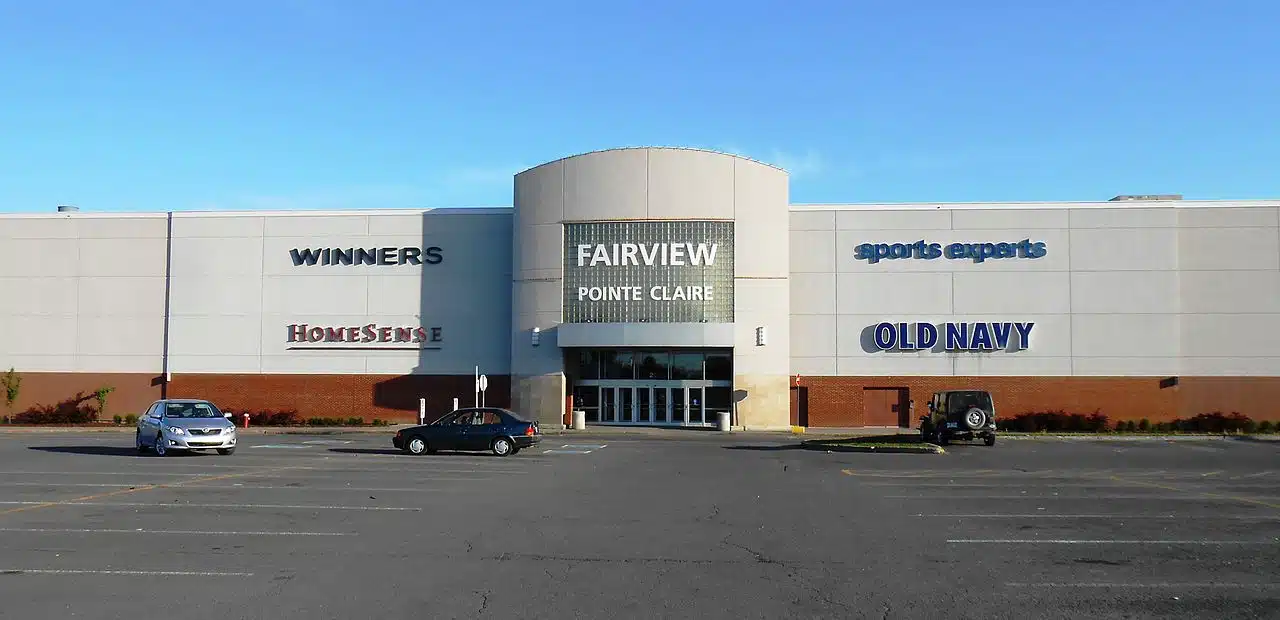
Fairview Pointe-Claire opened in 1965 at 6815 Route Transcanadienne in Pointe-Claire, Quebec, with roughly 81,600 sqm of gross leasable area and more than 160 retail and service units. The property is owned and managed by Cadillac Fairview as the largest enclosed regional shopping centre for the West Island of Montreal.
The West Island of Montreal, the communities west of Dorval along the Trans-Canada Highway, including Pointe-Claire, Kirkland, Beaconsfield, Baie-D’Urfé, and Sainte-Anne-de-Bellevue, is primarily an anglophone suburban community with one of the highest household income levels in the Montreal CMA. This linguistic and economic character shapes Fairview Pointe-Claire’s commercial positioning: the property serves a predominantly English-speaking consumer base in a French-majority province, and the tenant mix includes national and international retailers whose consumer-facing brand presence is comfortable in both languages while serving the everyday retail needs of a bilingual but anglophone-dominant community. Hudson’s Bay, the property’s traditional department-store anchor, permanently closed in June 2025 as part of the chain’s national liquidation. Zara, H&M, Aritzia and lululemon carry the fashion inline tenant base, with Apple, Best Buy and a LEGO Store among the electronics and entertainment tenants. The Trans-Canada Highway (Autoroute 40) frontage gives the property strong highway accessibility from across the West Island and from the Ontario border communities.
The West Island communities house 200,000 residents in the primary catchment, with the Vaudreuil-Dorion communities across the Lake of Two Mountains accessible via the Autoroute 40 corridor. The West Island is served by the Exo commuter rail network’s Vaudreuil-Hudson line, though transit connectivity to Fairview Pointe-Claire specifically remains primarily bus and car-dependent.
Cadillac Fairview manages Fairview Pointe-Claire as the West Island Quebec anchor within its national portfolio. The anglophone community demographic in a French-dominant regulatory environment creates a distinct commercial context: the West Island community’s retail preferences align more closely with Ontario suburban patterns than with the broader Montreal francophone consumer market, and the tenant mix reflects this cross-provincial linguistic boundary.