More than 40,000 stores across over 80 markets place Starbucks Corporation at the head of the global coffeehouse category. Listed on Nasdaq under SBUX and headquartered in Seattle, the company reported net revenue of approximately $36.2 billion in fiscal year 2024. Brian Niccol, who joined from Chipotle in September 2024 as chairman and CEO, authored the “Back to Starbucks” strategy that reorients the company toward the café experience, the handcrafted-beverage core, and the third-place positioning that defined the brand’s original growth, after a period of throughput-driven operations that had eroded the in-store experience and pressured comparable sales in the US and China.
The company traces to 1971, when three partners opened the first Starbucks as a whole-bean and ground-coffee retailer in Seattle’s Pike Place Market. Howard Schultz joined in 1982, and after a trip to Milan that exposed him to Italian espresso-bar culture, reoriented the business from bean retail toward the café model that became the global template. Schultz led the company through its 1992 IPO and two separate CEO tenures, and the third-place concept, the store as a social space between home and work, became the brand’s central real estate and cultural proposition. Starbucks pioneered the mobile-order-and-pay and loyalty-rewards infrastructure that much of the quick-service industry later adopted, with Starbucks Rewards now representing a substantial share of US transactions and the mobile app functioning as one of the most-used retail payment systems in the country.
Starbucks operates a mix of company-operated and licensed stores that shapes its retail real estate footprint differently by market. In the United States and China, its two largest markets, the company operates the majority of stores directly, giving it full control over site selection, format, and design. Across most international markets, Starbucks expands through licensed partnerships with regional operators: Alshaya Group across the Middle East, Alsea in Latin America and parts of Europe, and similar master-licensees elsewhere, who hold the local real estate relationships and operate stores under Starbucks standards. This dual model lets the brand scale into malls and high streets worldwide without carrying the full capital and operational burden in every market, and it explains the density of Starbucks in Gulf and Southeast Asian mall portfolios where licensed operators drive aggressive expansion.
The store portfolio spans multiple formats calibrated to location type. The full café with seating anchors the third-place model in malls, high streets, and mixed-use developments. Drive-thru formats dominate suburban and roadside US expansion. Compact and express formats serve transit stations, airports, and dense urban corridors. The premium Starbucks Reserve concept, and the small number of Reserve Roasteries, sit at the top of the brand hierarchy in flagship urban and luxury-mall locations. Within the Malls.com network, Starbucks holds positions across an exceptionally broad global set of Class A++ and A+ destinations: Dubai Mall, Mall of the Emirates, Dubai Hills Mall, and Yas Mall in the Emirates; The Avenues in Kuwait; Pavilion Kuala Lumpur and Gurney Plaza in Malaysia; SM Mall of Asia and SM Megamall in the Philippines; The Galleria and Cherry Creek Mall, Tysons Corner Center, and Grand Canal Shoppes in the United States; Toronto Eaton Centre and Vaughan Mills in Canada; and Złote Tarasy in Warsaw and Westfield Chodov in Prague across Europe.
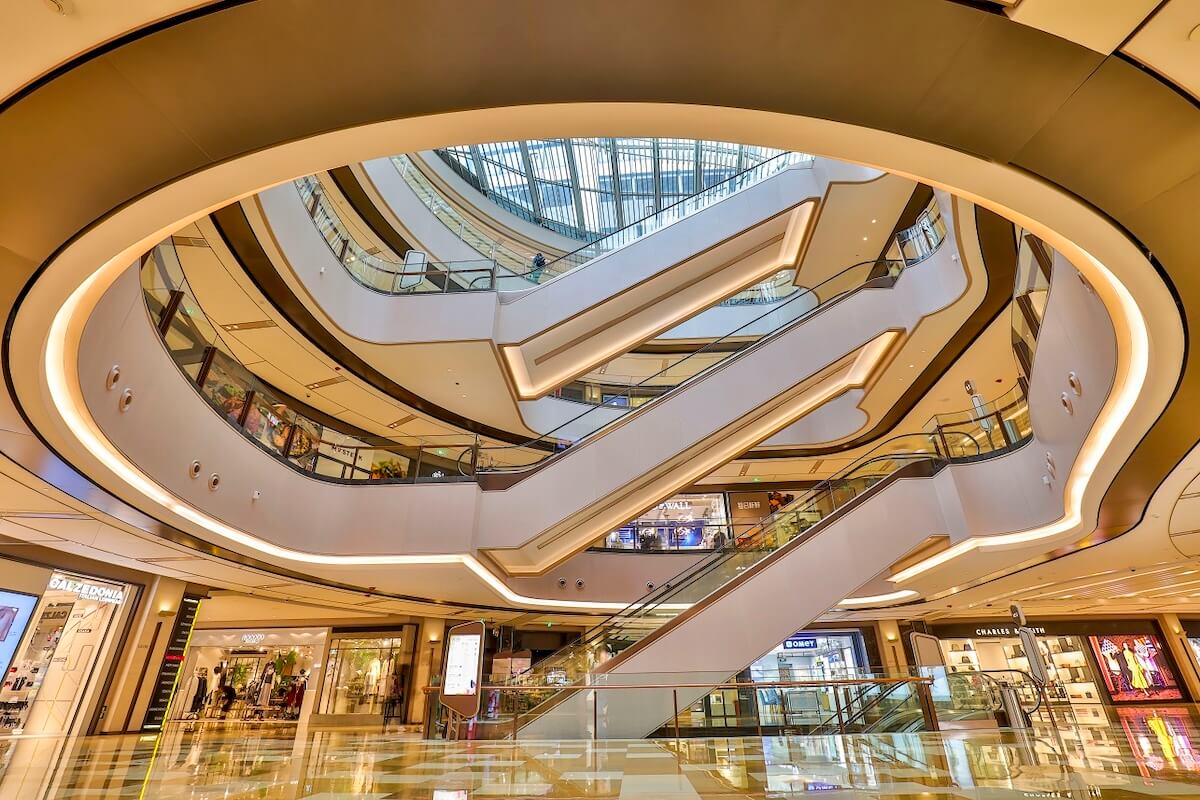
Inside a mall, Starbucks functions less as a coffee vendor than as a dwell-time and circulation anchor. A store extends the average visit duration, provides a natural rest-and-regroup point that supports longer shopping trips, and generates high-frequency repeat traffic on a daily rather than seasonal cycle, which is why landlords position the brand at high-visibility entrances, atriums, and circulation nodes rather than in food-court clusters. The typical mall footprint runs 1,500 to 2,500 square feet for a full café with seating, with compact formats fitting smaller inline and kiosk positions, and a Starbucks Reserve bar delivering a higher-specification format for premium and luxury centers. The consistency of the brand’s global standards and the creditworthiness of either Starbucks Corporation or its major licensed operators make Starbucks one of the few food-and-beverage tenants that landlords actively design circulation around rather than slot into leftover food-service space.