Grand Canal Shoppes is a resort retail property, not a conventional enclosed mall. Integrated within The Venetian and The Palazzo on the Las Vegas Strip, the roughly 875,000 square foot format operates on a customer capture model where the primary traffic source is the hotel’s room inventory, casino floor, and convention center rather than a surrounding trade area. The guest arriving at The Venetian is pre-qualified by room rate, travel intent, and disposable spending capacity before reaching the shopfronts. That pre-qualification dynamic makes Grand Canal one of the most productive lease environments in the United States on a revenue-per-square-foot basis, and it shapes every aspect of the tenant strategy.
The watch and fine jewellery offer at Grand Canal is unusually dense for a US resort retail property. Cartier and Hublot operate as confirmed boutiques, while specialist retailers and authorized brand points of sale represent A. Lange and Söhne, Breitling, IWC, Jaeger-LeCoultre, Montblanc, Panerai, and TAG Heuer. This concentration of Swiss watchmakers and fine jewelry houses within a single American resort property is possible specifically because resort capture economics justify the rent structure that these brands require for staffing, fixturing, and adjacency. In a conventional freestanding or mall location, the same brands would require the trade area demographics of a major metropolitan luxury cluster; at Grand Canal, the hotel occupancy rate performs that function.
Fashion and accessories confirm the positioning. Louis Vuitton, Burberry, Jimmy Choo, Stuart Weitzman, Ferragamo, Kate Spade, Tory Burch, and Michael Kors anchor the fashion register. Coach, Pandora, and Swarovski serve the accessible-premium layer that captures the middle of the resort customer spend range. Suitsupply and Tumi represent the business and travel category, consistent with the convention-traveler and business-visitor component of The Venetian’s guest mix. The breadth of the fashion spine at Grand Canal, from European flagship houses down to accessible contemporary brands, reflects the full range of the hotel’s guest income distribution.
Dining is not secondary at Grand Canal; it is structural to the dwell-time and capture-rate economics. CUT by Wolfgang Puck, Delmonico Steakhouse by Emeril Lagasse, TAO Asian Bistro, Fogo de Chão, Buddy V’s Ristorante, SUSHISAMBA, Sugarcane, and Mott 32 collectively represent a dining collection that would anchor a destination dining district in any major US city. The volume of celebrity-chef and destination restaurants within the property extends guest visit duration measured in hours, not minutes, and converts the shopping occasion into a full-evening program that supports adjacent retail spending throughout the stay.
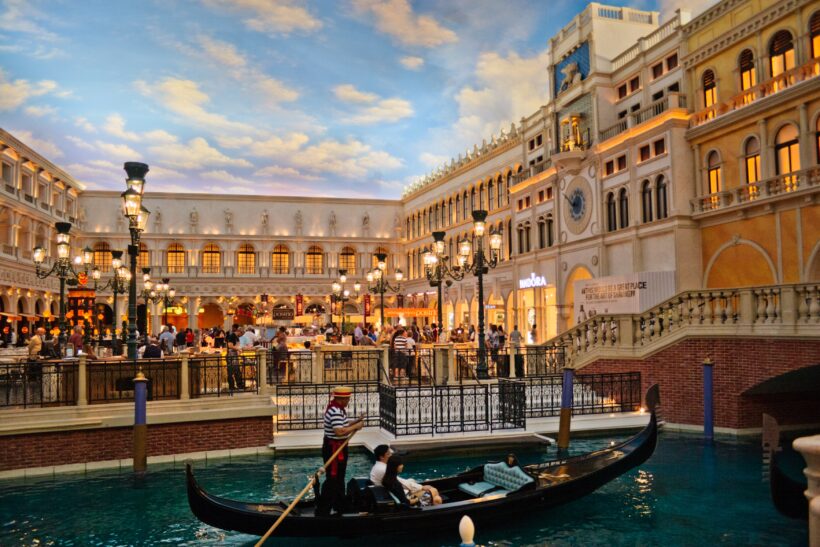
The gondola canals, painted-sky ceilings, and Venetian-themed architecture create a physical environment that brands use as part of their own global positioning narrative, one of a small number of US properties where the tenant mix and customer profile align with genuinely flagship-level ambition. The competitive set here is The Forum Shops and The Shops at Crystals, not the department-store-anchored malls of the broader Las Vegas metro.
Sit-down dining at the property includes Fogo de Chão. Quick options include Chipotle, Five Guys, Johnny Rockets, Panda Express and Popeyes.
Other attractions at the property include Sandbox VR.
Records updated 22 July 2026.
Verified signals on brand expansion, store openings, and mall development. Free.
Free · No credit card · Unsubscribe any time