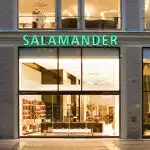
The salamander emblem has been a recognized European footwear mark for more than 130 years, attached to a German shoe brand founded in 1885 in Kornwestheim near Stuttgart by Jakob Sigle and his partners. Salamander grew through the early twentieth century into Germany’s largest mass-market shoe retailer, with the iconic Lurchi children’s character and the company’s vertically integrated manufacturing model defining its position in the German cultural memory of post-war consumer recovery.
Ownership of Salamander passed through several restructurings across the twentieth and twenty-first centuries, with the brand most recently controlled by the Austrian ARA Group following acquisitions in the 2010s, and the Salamander retail and product business now operating as a subsidiary specialty footwear concept within ARA’s broader European shoe distribution structure. ARA AG itself is the Austrian premium-comfort women’s shoe specialist headquartered in Langenfeld. The combined business operates manufacturing across Austrian, German, and select Mediterranean factories, with Salamander positioned as the German heritage banner and ARA as the premium-comfort women’s specialist. Annual revenue across the Salamander business is estimated in the range of €100 to €150 million, with the company having undergone significant rationalization of underperforming stores and a shift toward selective premium positioning rather than the volume mass-market model of earlier decades. The Lurchi children’s character continues as the brand’s mascot, with associated children’s footwear and storybook programs maintaining recognition across multiple generations of German consumers.
Salamander operates a network of approximately 150 stores across Germany, Austria, and Switzerland, supplemented by shop-in-shop placements inside department stores and a wholesale presence in multi-brand shoe specialty retail across Central Europe. For mall operators, Salamander is a Class B and Class B+ specialty footwear tenant typically taking 100 to 250 square meters, fitting alongside Gabor, Rieker, Tamaris, and similar German-market premium-comfort shoe brands. The brand’s strongest mall positioning is in regional centers across the DACH markets, serving family demographics with multi-generational shopping patterns.
Verified signals on brand expansion, store openings, and mall development. Free.
Free · No credit card · Unsubscribe any time