Primark is a fast-fashion retailer owned by Associated British Foods, known for offering trendy clothing and accessories at very low prices.
Primark is the value-fashion retailer operated by Associated British Foods plc, the FTSE 100 diversified conglomerate listed on the London Stock Exchange under ABF that also operates Twinings, Ovaltine, Jordans cereals, Allinson’s flour, Mazola, and a substantial sugar-and-agriculture business. The Weston family retains controlling ownership of ABF through Wittington Investments, with George Weston serving as Chief Executive of Associated British Foods. Primark represents the largest single profit contributor within the ABF portfolio, exceeding the combined contribution of the group’s food banners.
Founded in 1969 in Dublin, Ireland by Arthur Ryan as Penneys (a banner still used in Ireland), the chain expanded into the United Kingdom in 1973 under the Primark name and built its market position around a deliberate strategy of zero direct-to-consumer e-commerce, relying entirely on brick-and-mortar stores to deliver low-price fast fashion. The strategy distinguished Primark from Zara, H&M, and the broader fast-fashion segment for decades, with the chain achieving among the lowest unit prices in mainstream fashion retail through volume-driven sourcing, minimal markdown cycles, and high-density large-format stores. Primark generated revenue of approximately £9.4 billion in fiscal year 2024 (ended September 14, 2024), up 6% year-over-year, with adjusted operating profit of approximately £1.1 billion. CEO Paul Marchant resigned in March 2025 following an investigation into his conduct, with Eoin Tonge appointed Interim CEO during the leadership transition. Primark launched its first-ever transactional e-commerce capability in 2024 in the United Kingdom, marking a major strategic pivot after decades of stores-only positioning, with continued rollout into additional markets through 2025 and 2026. The brand has not entered the Russian market in its history.
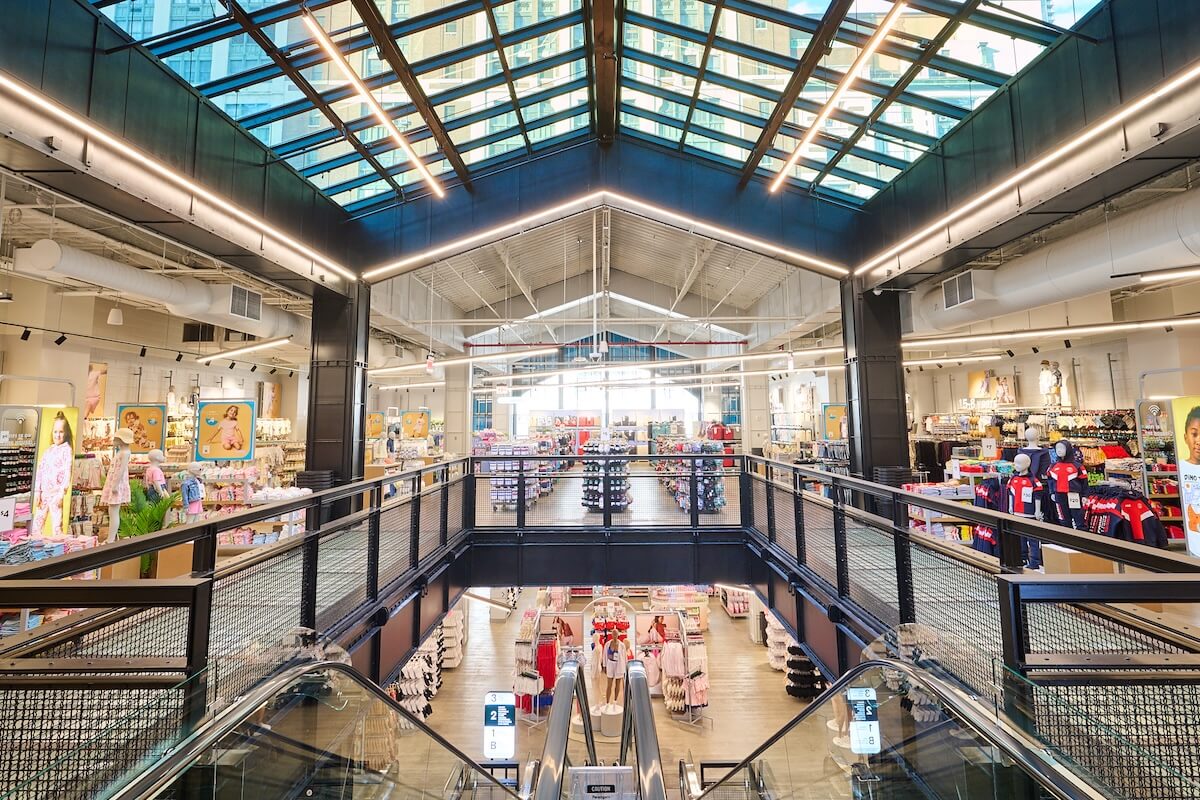
The United States represents the company’s most active growth market, with Primark targeting 60 US stores by the end of fiscal year 2026 from approximately 30 locations in late 2024, anchored by the Jersey City flagship that opened in 2024 as one of the largest single-store openings in modern US fashion retail. The continental European footprint has grown to substantial scale across Spain, France, Germany, Italy, the Netherlands, Belgium, Austria, Portugal, the Czech Republic, Poland, Slovenia, Slovakia, Hungary, and Romania, with Italy and Iberia among the strongest-performing markets by store productivity. The typical Primark store occupies 3,500 to 7,000 square meters, with flagship locations extending to 12,000-plus square meters in major urban destinations. For mall operators, Primark is a Class A specialty fashion anchor capable of operating as a primary anchor for regional and super-regional centers, frequently absorbing footprints vacated by department stores during the 2010s and 2020s anchor-rotation cycle. Co-tenancy with H&M, Zara, Uniqlo, and grocery-and-mass anchors defines the typical mall positioning, with Primark functioning as a traffic-driving value anchor that benefits adjacent retail through high foot traffic and family-shopper demographics.