
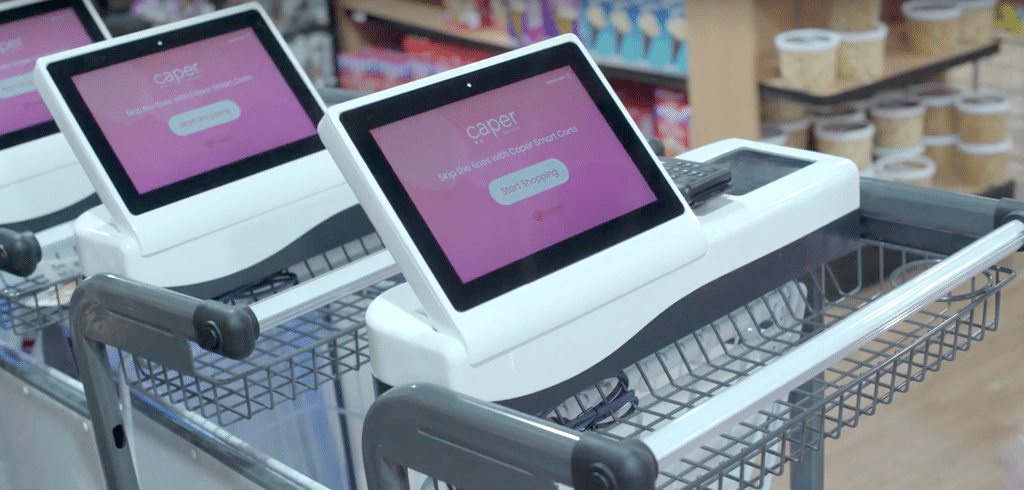
Startup Caper attracts investors with its “basket of the future” project for simple and convenient shopping in supermarkets.
It is about creating a trolley that will use computer vision and many sensors to scan goods on the go.
Caper announced the closing of a new round of investments of $10 million, which was attended by Lux Capital and several Silicon Valley venture funds. To date, the startup has already attracted $13 million. The company expects that the new technologies will allow traditional grocery retailers to keep pace with Amazon, which has doubled the automation in retail with the launch of the Amazon Go store format.
Unlike Amazon Go, which uses a complex system of sensors and cameras throughout the store, the Caper solution focuses solely on what happens inside the shopping cart. The exact cost of the “smart” basket is not reported, but it is known that we are talking about “hundreds of thousands of dollars” to equip one store. For comparison, in the equipment of the first shop of the future Amazon, it has been invested about 1 million dollars.
“Instead of monitoring the entire store, we are focusing on this tiny cart. Our calculations are much faster, our cameras are much closer, and we can scale the project much faster because we don’t need to implement any infrastructure inside the store,” said Caper’s technical director and co-founder York Young.
The shopping cart of the future is expected to include a bank card reader, barcode scanner, and image recognition cameras for fast self-purchase at the store. The smart trolley touchscreen will display personalized recommendations as well as shopping lists and recipes according to the perfect shopping experience.
According to Young, the company’s central vision in creating an innovative product is to create a “platform level in the retail trade that has never existed before.”
European retail is scaling AI, agentic commerce and retail media, but consumer trust is becoming the constraint. Four structural shifts…
Mall operators are no longer leasing space for pop-ups. They are selling audience access.
Physical stores still drive most retail sales, fulfill online orders, support AI shopping, and help brands return to market.
A practical guide to nine mall tenant formats in 2026, from flagships and pop-ups to anchor redevelopment and mixed-use retail.
1,051 of 1,173 US malls hold zero ultra-luxury brands. Half of all Cartier, Chanel, Hermès, and Louis Vuitton mall stores…
Every physical expansion decision starts with the same question: where does the store go?
Verified signals on brand expansion, store openings, and mall development. Free.
Free · No credit card · Unsubscribe any time
