
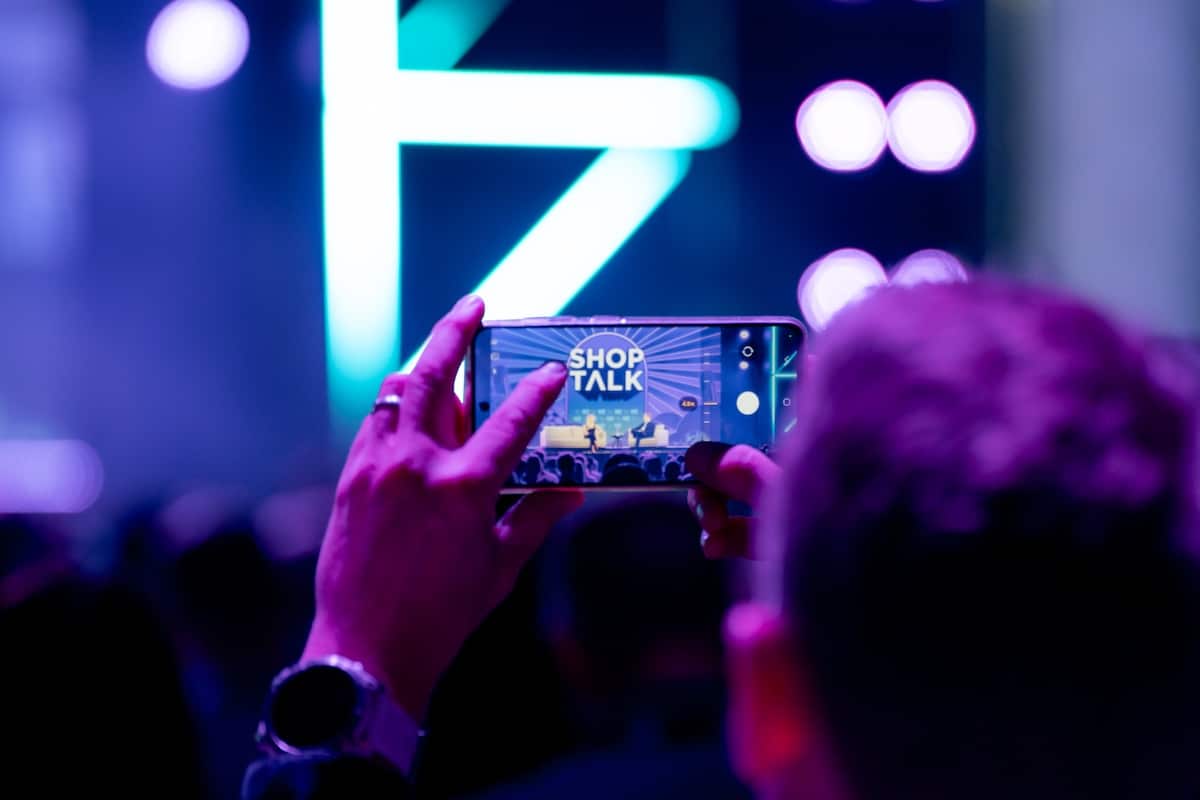
European retail is scaling AI, agentic commerce and retail media, but consumer trust is becoming the constraint. Four structural shifts from Shoptalk Europe 2026.
Four thousand five hundred senior retail leaders gathered at Fira Gran Via in Barcelona in June 2026 for Shoptalk Europe. Malls.com covered the event as accredited press. The sessions, the official research releases, and the conversations that happened between them produced a consistent picture of where European retail is heading.
The picture is this: every category of technological capability available to European retailers is growing. AI adoption, retail media infrastructure, agentic commerce protocols, recommerce platforms, and demand sensing tools are all scaling. The constraint is not access to these capabilities. The constraint is trust: the consumer’s willingness to let technology mediate their decisions, the brand’s ability to earn local relevance, the retailer’s capacity to connect machine-driven commerce with human confidence.
That is the thread that runs through all four structural shifts that emerged from Barcelona.
Holden Bale, Chief Strategy Officer at Merkle, opened the AI track with the clearest number of the conference: 88 percent of enterprises surveyed have implemented AI in some form. Only 6 percent can draw a direct line from that implementation to EBITDA value.
The gap is not philosophical. It is architectural. The session on data readiness, moderated by Carlos Sanchez Altable of McKinsey, produced the same diagnosis from three different companies. Graeme Smith of Zalando described 15 years of building AI infrastructure before the results became measurable. Fiona Tan, Chief Technology Officer at Wayfair, described treating data as a product with clear ownership, governance, and service level agreements. Maximilian Einöder of MediaMarkt Saturn described the challenge of harmonizing data across 11 European markets for 50 million loyalty members.
Zalando’s numbers are the proof case for what comes after that foundation is built. Ninety percent of the platform’s site content is now AI-generated, up from near-zero a year ago. Its AI assistant grew from 6 million users in 2025 to 10 million users by the first quarter of 2026. AI-powered size recommendations have reduced returns by 8 percent. These are not feature announcements. They are operating metrics from a company that spent a decade building the data layer before the AI layer.
The practical instruction from the conference was contained in one exchange during the key takeaways session. Adam Plom, VP of Content at Shoptalk Europe, summarized the executive consensus: AI value right now is operational, not customer-facing. Supply chain, forecasting, content generation, and creative production are where the measurable returns are appearing. Customer-facing AI is the next step, not the current one. Reality is efficiency. Autonomy is still being built.
The European AI gap in 2026 is not between believers and sceptics. It is between companies that have done the data infrastructure work and companies that have not started it.
The second structural shift is the fragmentation of discovery. Pinterest reported visual search growth of 44 percent in the prior year, with 96 percent of searches arriving on the platform unbranded. Consumers are not searching for products they have decided to buy. They are browsing for possibilities they have not yet named. TikTok Shop announced at the conference its expansion to Austria, Belgium, the Netherlands, and Poland, extending its European footprint to 10 markets. Daily gross merchandise value across existing European markets delivered triple-digit growth between August 2025 and February 2026. That growth is not driven by search intent. It is driven by content discovery, where the product appears inside entertainment before the consumer has expressed any purchase intention.
Beneath both of these is a harder infrastructure shift. The session on agentic commerce featuring Dido Schmidt, Director of Global Partnerships at Google, and Mark Elkins, General Manager for Global Ecommerce at L’Oréal, produced the most practically demanding instruction of the conference. Agents are not browsers. They execute against a specification. They require accurate, structured, enriched product data. Brands whose product information is thin, inconsistent, or poorly structured for machine consumption will not appear in agent-mediated purchase flows. Those whose product data is enriched and machine-readable will.
Elkins described the scale of work required: five times more data content per product, produced at ten times the current speed, to be competitive in an agent-mediated environment. L’Oréal has built semi-automated workflows that save over an hour per product detail page and is developing joint value plans with retail partners to align on how product data flows through agent systems.
Andrew Lederman of Mondelēz International framed the principle as simply as anyone at the event: wherever the discovery experience goes is where the dollars will go.
Shoptalk’s own Merkle research found that 37 percent of US consumers were regularly using AI tools for shopping in November 2025. By February 2026 that figure had risen to 47 percent. Europe is 6 to 12 months behind, based on protocol rollout timelines. The window to prepare is open. It is not large.
The third structural shift is the clearest continuation of Malls.com’s editorial territory.
Peter Ruis, Managing Director at John Lewis and Partners, described the retailer’s loyalty data at the keynote: every market where John Lewis has closed stores shows a measurable loss of online customers in that catchment area. The physical store does not compete with e-commerce. It generates e-commerce demand. Kingfisher, the home improvement group behind Castorama, B&Q, and Screwfix, reported that 90 percent of its first-party online transactions are processed through its stores. MediaMarkt Saturn operates 71 percent of its sales through brick-and-mortar across 11 European markets.
Alexis Rollier, Global Chief Operating Officer at Sephora, described how the company’s 3,000 stores have been reorganized around this understanding. Stores function as experience environments, fulfillment hubs, and service centers simultaneously. Store directors carry unified customer data to make decisions in real time. AI-powered beauty scan tools provide instant skin tone analysis and tailored recommendations inside the store. The app extends the brand relationship between store visits through launches, trends, inventory visibility and service tools. The store is one node in a connected system, not a standalone transaction point.
Katie Reeves, Chief Commercial Officer at COS, described deploying RFID ceiling readers and an associate app to deliver real-time inventory visibility. The goal was not to reduce headcount. It was to free associates from administrative tasks so they could spend time with customers. Technology makes the interaction more human by removing the parts that are not.
Tesco’s Shopper Mindsets research, shared by Tash Whitmey of Tesco Media and Insight Platform, found that 69 percent of purchase decisions occur during the shopping journey, not before it. IAB Europe forecasts a European retail media market of 31 billion euros by 2028. Nectar360, Sainsbury’s retail media operation, has reduced creative production timelines from three weeks to 90 seconds through its AI-powered Pollen platform. The physical store is not separate from this media infrastructure. It is its highest-intent surface.
Mark Blundell, Chief Retail Officer at Harrods, described the operating logic in the session on temporary retail spaces. Harrods does not evaluate pop-ups on revenue alone. The Burberry Daniel Lee launch generated 15.9 million social media points and brought in 18 percent new buyers. Commercial return was secondary. The store was the event infrastructure, and the event was the media buy.
Confidence is the new currency. That phrase emerged from the discovery commerce panel as the synthesis of Pinterest, TikTok Shop, and Reddit’s combined observations about how consumers actually convert in a fragmented media environment. They arrive with a shortlist assembled from agents, feeds, and peer recommendations. For many considered purchases, the store is where consumers confirm the choice.
Digital commerce builds the shortlist. Physical retail can close the confidence gap.
The fourth structural shift challenges the model that has driven most international retail expansion for the past two decades.
A globalization session cited research suggesting that up to three quarters of international brand expansion attempts are now failing. The Western brand halo has diminished. Local challenger brands are winning through cultural specificity that standardized global rollouts cannot match.
Ashley Kechter, Global President at Vuori, described the company’s strategic response as density before breadth. Multiple stores in China, the United Kingdom, Korea, and the Middle East before wider expansion. Local teams as a learning loop. No store opening until the market understanding is deep enough to justify it. The alternative is the failure rate cited in that research.
Nadine Graf, President for Europe at The Estée Lauder Companies, described the same logic operating in reverse. The company’s kajal eyeliner, developed for the Indian market, is now under consideration for global markets. The direction of brand intelligence is no longer one-way from headquarters to market. Local markets are generating innovations that global portfolios are learning to adopt.
Alexis Mourot, COO at Christian Louboutin, described a retail model built on deliberate local differentiation. Selected stores carry city-specific products unavailable elsewhere. Customers are motivated to visit multiple locations globally. Scarcity is structural, not promotional.
Recommerce is the extension of the same principle into product lifecycle. McKinsey and the Business of Fashion forecast the global second-hand fashion market to grow from 168 billion euros to 270 billion euros by 2027. Recommerce depends on a wider trust contract: confidence in authenticity, condition, pricing, logistics, and the value of store credit. Platforms that establish that trust can keep both the product and the customer relationship inside the brand ecosystem.
At IKEA, 65 percent of sellers in its recommerce program take store credit over cash, and 80 percent of those spend it on higher-value goods. Twenty-five percent of IKEA’s recommerce buyers are new to the brand entirely. The second product lifecycle is generating first-time customers.
Vestiaire Collective, with one billion euros in GMV and 6 million active product listings, is targeting its first annual profit in 2026. CEO Bernard Osta framed the competitive context: the real competition for recommerce is not Vinted or The RealReal. It is the 93 percent of fashion still sold new. Second-hand is converting demand that would otherwise not have been captured.
For the retailer and the mall operator, recommerce creates a reason to return. The store that accepts, authenticates, resells, and credits creates a visit frequency that the store selling only new products cannot match.
Shoptalk Europe’s official predictions for the decade ahead identified five shifts. Two of them received less attention in the sessions than their eventual scale justifies.
The first is GLP-1 medications. Roughly 1 percent of the global population currently takes appetite suppressants. Morgan Stanley forecasts that could reach 10 percent over the next decade. Rhian Thomas of IGD presented research projecting that by 2030, 15 percent of the UK population could be on GLP-1 medications. Kantar data found that 46 percent of GLP-1 users have already changed where they do their main grocery shop. The categories under pressure include crisps, savoury snacks, and sweet bakery. The categories gaining include high protein, smaller portions, on-the-go convenience, and digestive health. Apparel will see a secondary effect as body composition changes and wardrobes require updating. Most retailers have not yet built this shift into their merchandising or category planning.
The second is demand sensing. Unilever’s adoption of real-time demand sensing, using live sales data, weather, social signals, and promotional calendars to replace static forecasting, has reduced forecast errors and cut safety stock. Tomas Cupr, founder of Duvo and previously the founder of a two-billion-euro retailer, described the current reality: 80 percent of retail operations staff time is spent acting as human connectors between systems that cannot communicate directly. AI agents can eliminate most of that. The retailers who deploy this capability before the next Black Swan event will have a structural cost advantage over those still running static planning cycles.
Europe is not short of AI pilots, media networks, or store technology.
It is short of operating models that connect them without eroding the consumer’s willingness to trust.
The brands winning in European retail in 2026 have understood the sequence. Machine-readable product data gets the brand into the agent’s shortlist. Physical presence confirms the decision and builds the confidence that digital cannot replicate. Local relevance earns the loyalty that standardized global rollouts are losing. Recommerce closes the product lifecycle and opens a new acquisition channel.
At each stage, the constraint is the same. Consumers will let technology mediate their discovery. They will not yet let it replace their judgment. The store, the trusted advisor, the locally relevant brand, and the product that can be returned, resold, and bought again are all forms of the same thing: evidence that the brand can be trusted.
That was the clearest signal from Barcelona.
Technology is scaling. Trust is becoming the constraint. The retailers who build for both will be the ones still relevant when the next decade’s predictions are made.

Gross margins and selected profit metrics for Coach, Pop Mart, lululemon, Miniso, Five Below, TJX and Costco, plus where each…
NikeSKIMS, Birkenstock and Starbucks Reserve chose HKRI Taikoo Hui for major China debuts. Why the Shanghai complex keeps winning new…
Bluewater opens its first new anchor since 1999. Next takes the former House of Fraser space with about 132,000 square…

Opening in IMAX 70mm on July 17, 2026: Christopher Nolan's The Odyssey. Select shows went on sale one year in…
Mall operators are no longer leasing space for pop-ups. They are selling audience access.
Physical stores still drive most retail sales, fulfill online orders, support AI shopping, and help brands return to market.
