
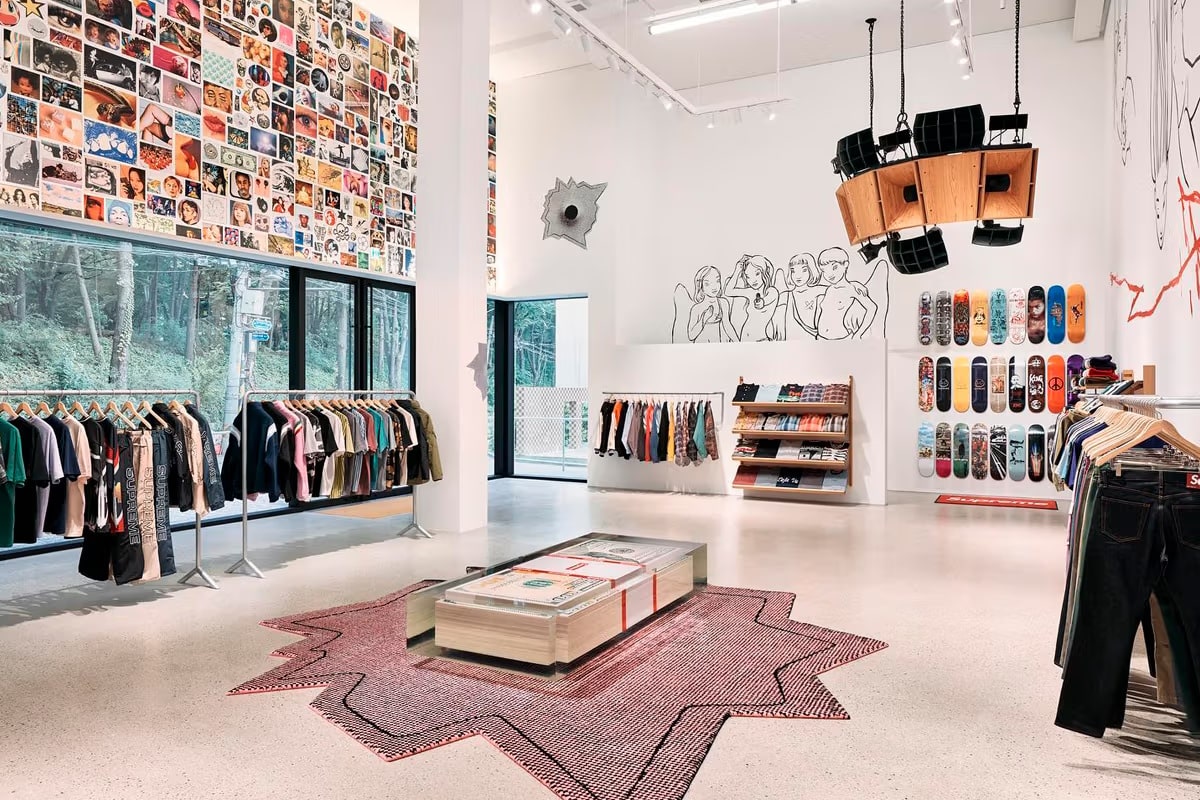
New York-based streetwear brand Supreme is opening its first store in Seoul.
Supreme opened its first South Korean store in Seoul in August 2023, establishing a directly operated presence in a market it had previously reached only through resale channels and cross-border buyers.
The store sits in Sinsa-dong, in the upscale Gangnam-gu district near Dosan Park, in a standalone building whose upper two floors hold Supreme’s local office. The brand had set up a representative office in South Korea earlier in 2023, and the office-above-store structure signals permanent market infrastructure rather than a test format.
Seoul is Supreme’s 16th standalone store worldwide and its second in Asia after Japan, extending the brand across seven countries: the US, UK, France, Italy, Germany, Japan and South Korea. The opening followed the brand’s China debut a year earlier through a store-in-store at Dover Street Market in Beijing.
The store was designed by Brinkworth, Supreme’s longtime London-based design partner. A pared-back exterior carries a single Box Logo banner, while the interior runs to clothing racks, display cases of apparel and skateboard decks, a custom-built sound system and commissioned murals and pop-culture collages, the visual language Supreme repeats across its flagships.
The opening was marked with an exclusive Box Logo T-shirt and hoodie printed with mugunghwa, the hibiscus that serves as South Korea’s national flower, alongside the store address. The localised product reads as a market-entry gesture rather than a standard drop, tying the brand’s arrival to the specific city it was entering.
For Supreme, owned by VF Corporation since 2020, a directly operated Gangnam flagship converts an established resale and grey-market demand base into a controlled retail channel. Locating among luxury neighbours frames the brand’s Korean positioning as premium streetwear rather than mass-market.
European retail is scaling AI, agentic commerce and retail media, but consumer trust is becoming the constraint. Four structural shifts…
Mall operators are no longer leasing space for pop-ups. They are selling audience access.
Physical stores still drive most retail sales, fulfill online orders, support AI shopping, and help brands return to market.
A practical guide to nine mall tenant formats in 2026, from flagships and pop-ups to anchor redevelopment and mixed-use retail.
1,051 of 1,173 US malls hold zero ultra-luxury brands. Half of all Cartier, Chanel, Hermès, and Louis Vuitton mall stores…
Every physical expansion decision starts with the same question: where does the store go?
Verified signals on brand expansion, store openings, and mall development. Free.
Free · No credit card · Unsubscribe any time
Billed annually · View full comparison · Payment via invoice or PayPal
