Rubin Organization developed Cumberland Mall, opening October 21, 1973, in Vineland, New Jersey, on Route 47 at the Route 55 interchange, positioned roughly 25 miles from its nearest mall competitor and 45 miles south of Philadelphia. Original anchors were Bradlees, Gaudio’s and Wilmington Dry Goods, with a Pathmark supermarket operating just outside the enclosed structure.
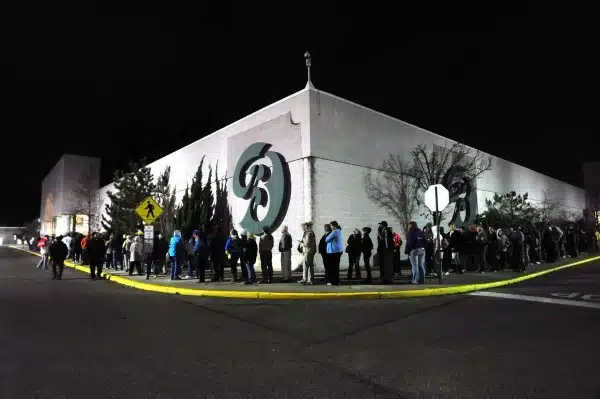
Wilmington Dry Goods became Value City through the 1980s, and JCPenney was added as a further anchor in a 1977 expansion, distinct from the Gaudio’s space, which later became a Clover store before eventually becoming Boscov’s; the exterior Pathmark was later replaced by a Toys “R” Us. Bradlees went bankrupt in the early 2000s, with its space subdivided into Marshalls, Michael’s and a Bed Bath & Beyond (which closed this location in 2018, years before the chain’s broader 2023 national bankruptcy); Value City closed in 2008 and was replaced by Burlington Coat Factory in 2009, and the original JCPenney closed in 2015, replaced by Dick’s Sporting Goods.
At roughly 941,148 sqft, the property currently carries five anchors, Boscov’s, Burlington Coat Factory and Dick’s Sporting Goods among them, plus a separate 80,000 sqft distribution center on site that has occupied a former anchor space since 2021, providing order-fulfillment services for businesses inside and outside the mall. Pennsylvania Real Estate Investment Trust (PREIT), the mall’s longtime owner, sold the property to Kohan Retail Investment Group for $45 million in November 2022; Summit Properties USA, a subsidiary of UK-based Summit Properties Ltd., acquired the mall as part of a roughly $700 million multi-property acquisition completed in December 2024 and is the property’s current owner. Ulta and Old Navy round out the broader tenant base alongside Marshalls and Michael’s.
That anchor-subdivision pattern, Bradlees’ single vacated department-store footprint splitting into three distinct smaller retailers rather than attracting one direct replacement, mirrors a format shift seen at other aging 1970s-era regional malls in this batch, reflecting how thoroughly the department-store-anchor model has given way to multi-tenant big-box subdivision as the default redevelopment path for large vacated anchor spaces.