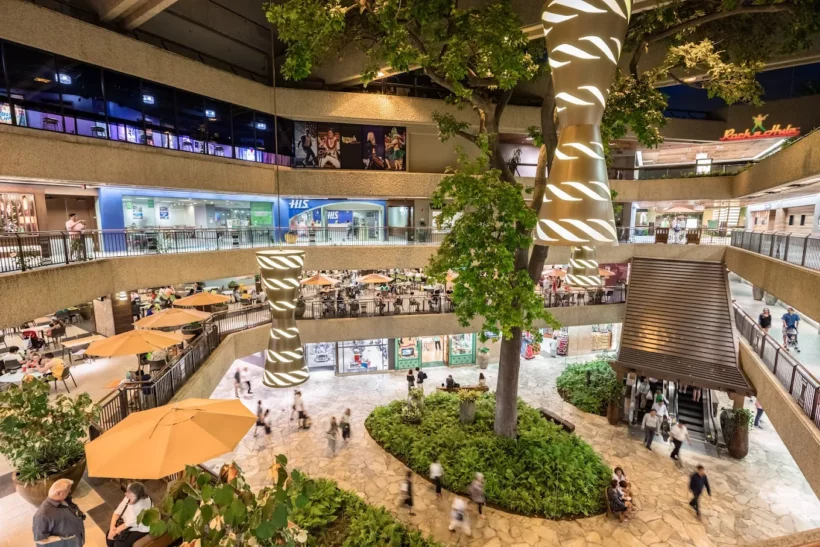
Royal Hawaiian Center is a 300,000 square foot A+ lifestyle center located in Waikiki, Honolulu, Hawaii, operated by Kamehameha Schools. Originally opened in 1979 and substantially redeveloped with a completion in 2007, the property sits along Royal Hawaiian Avenue in the core of Waikiki’s retail corridor, functioning as an open-air shopping destination oriented toward premium and luxury retail.
Waikiki draws millions of visitors annually from the continental United States, Japan, South Korea, Australia, and broader Asia-Pacific markets, creating a consumer base that skews toward discretionary and luxury spending. The property sits within walking distance of the major Waikiki resort hotels concentrated along Kalakaua Avenue and the beachfront, positioning it directly in the path of high-spending leisure travelers. Local demand from Honolulu’s established residential neighborhoods, including Kahala and Manoa, supplements visitor traffic, though the trade area dynamic here is driven far more by tourism volume than by a traditional residential catchment. Hawaii’s geographic isolation and Waikiki’s role as the primary entry point for island visitors give this location a concentration of qualified spending that few open-air retail settings in the United States can match on a per-visitor basis.
The anchor tenant lineup of Hermès, Fendi, Tiffany and Co, Valentino, and Ferragamo establishes Royal Hawaiian Center firmly at the top of the luxury market. This concentration of European fashion houses and fine jewelry anchors a tenant structure built around hard luxury, accessories, and premium apparel. The remaining tenant mix extends across luxury fashion brands, resort-oriented retail, beauty, and dining, with a format designed to support extended visits from guests who are spending leisure time rather than running errands. The open-air structure reinforces that experience, connecting retail to the broader Waikiki environment and making the property a destination in its own right rather than a transactional stop.
Brands evaluating Royal Hawaiian Center should account for the visitor-driven traffic profile when modeling performance. Sales velocity here correlates with tourism volume and the spending patterns of international visitors, particularly from Asia-Pacific markets where demand for European luxury goods and American premium brands runs strong. The property suits luxury fashion, fine jewelry, accessories, and experiential concepts that convert high-intent leisure shoppers rather than relying on repeat local visits. For a brand seeking a single Hawaii door, Royal Hawaiian Center is the address that places it at the center of the island’s highest-traffic luxury shopping corridor, with the anchor composition to support positioning at the top of the market.