
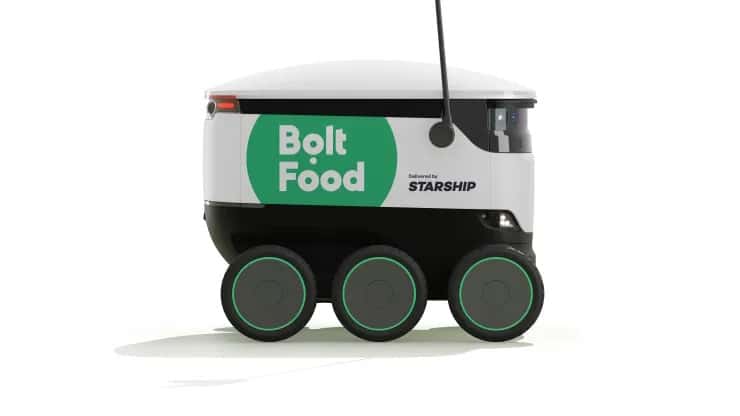
The company plans to launch online food delivery in its home city of Tallinn.
Bolt, a European technology company valued at $8.4 billion, has announced its foray into food delivery using a fleet of self-driving robots provided by American robotics firm Starship Technologies.
This commercial partnership between Bolt and Starship is expected to expand beyond Estonia to encompass other countries where both companies operate. Bolt, an Estonian company, aims to bring food directly to people’s doorsteps by leveraging a fleet of autonomous robots through this collaboration with Starship Technologies.
The company plans to launch online food delivery in its home city of Tallinn by the end of this year as part of the initial deployment of Starship robots. Like ordering food through online applications, Bolt’s partnership with Starship will allow users to receive their meals with just a tap of a button, delivered by robots. Once the robot arrives at the user’s doorstep, they can press a button to open it and retrieve their ordered dishes or products.
“We are focused on providing well-rounded solutions to help make local transportation as sustainable as possible,” Markus Villig, founder and CEO of Bolt, said in a statement Wednesday. “Starship offers a smart and much-loved service that has proven itself over the past five years and we’re excited to introduce this service to more people.”
Bolt, known for challenging Uber in key international markets, particularly in the United Kingdom, is one of Europe’s most highly valued technology companies. Over the years, the company has expanded its operations into various sectors, including online food, grocery delivery, and electric scooters.
Founded in 2013 and previously known as Taxify, Bolt boasts approximately 100 million customers across 45 countries in Europe, Africa, the Middle East, and Latin America.
Bolt has raised over $2 billion in funding from investors such as Sequoia, the International Finance Corporation (IFC), and the European Investment Bank.
Bolt plans to commence delivery services in Tallinn in the coming months and expand its robot fleet to other markets later
NikeSKIMS, Birkenstock and Starbucks Reserve chose HKRI Taikoo Hui for major China debuts. Why the Shanghai complex keeps winning new…
Bluewater opens its first new anchor since 1999. Next takes the former House of Fraser space with about 132,000 square…

Opening in IMAX 70mm on July 17, 2026: Christopher Nolan's The Odyssey. Select shows went on sale one year in…

European retail is scaling AI, agentic commerce and retail media, but consumer trust is becoming the constraint. Four structural shifts…
Mall operators are no longer leasing space for pop-ups. They are selling audience access.
Physical stores still drive most retail sales, fulfill online orders, support AI shopping, and help brands return to market.
Verified signals on brand expansion, store openings, and mall development. Free.
Free · No credit card · Unsubscribe any time
