
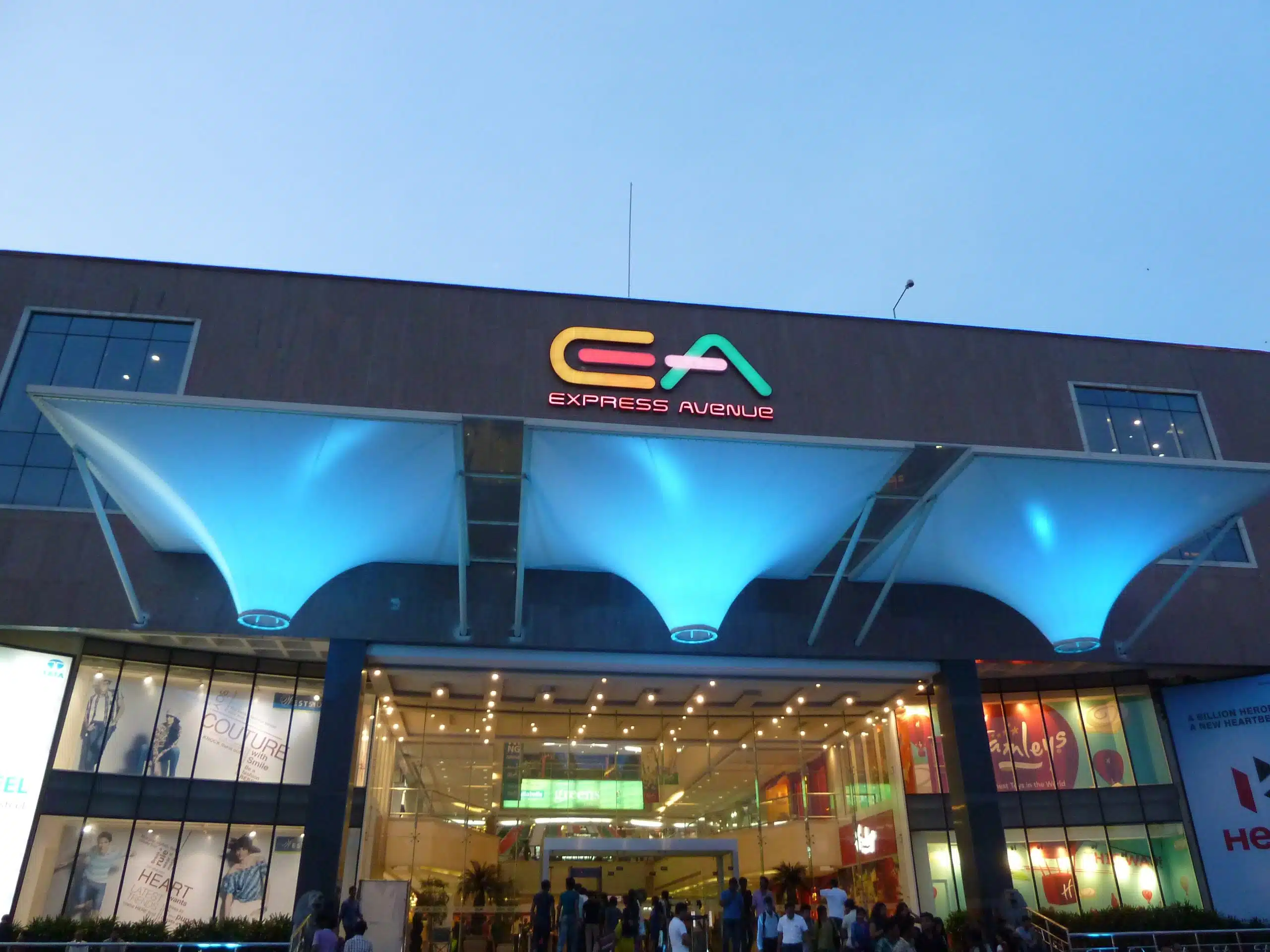
Express Avenue sits on what was, until 1947, the Madras Club, India’s second-oldest gentleman’s club after Calcutta’s Bengal Club. Ramnath Goenka, the newspaper magnate who built the Indian Express media empire, bought the estate after independence and ran the Indian Express’s editorial operations from the site for decades before his heirs’ holding company, Express Infrastructure, redeveloped it into a shopping mall.
Managing Director Kavita Singhania oversaw the ₹750 crore project through persistent skepticism that Chennai’s traditionally modest retail spending could support a large-format luxury mall. Architect Mohit Gujral designed the site around six atriums, each at least 75 feet high and topped with tensile fabric that lets in daylight while giving the common areas a translucent, outdoor feel. Express Avenue opened on May 26, 2010, becoming, by most measures, the largest shopping center in South India at the time, with roughly 900,000 sqft of retail space across four floors plus a hotel and office towers on the same site.
H&M, Pantaloons, Lifestyle and Forever 21 anchor a roster that runs past 250 stores, alongside Escape, an eight-screen PVR multiplex designed by California-based artist Giovanni Castor, and Games The Shop, which the mall describes as South India’s largest gaming arcade. The 44-room E Hotel and roughly 200,000 sqft of office space, priced to compete directly with Chennai’s IT parks and special economic zones, sit on the same 10-acre site as the retail floors.
That media-company-turned-developer origin is unusual even by Indian mall standards, where most large-format centers trace back to construction or industrial conglomerates rather than newspaper groups repurposing a colonial-era social club into a shopping and hospitality complex.
Verified signals on brand expansion, store openings, and mall development. Free.
Free · No credit card · Unsubscribe any time


