
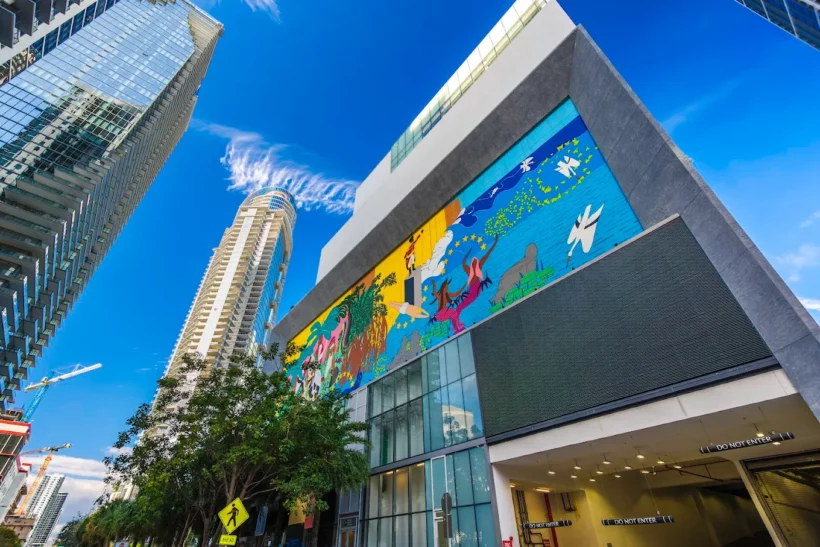
Miami Worldcenter is a 300,000 square foot Class A mixed-use property in downtown Miami, Florida, with the retail component operated by CIM Group and The Comras Company. The development combines retail, dining, residential, and office uses within a master-planned urban district, opening its retail components in phases primarily through late 2022 and 2023. The format functions as an open, walkable retail environment rather than a traditional enclosed mall, drawing traffic from residents, office workers, hotel guests, and visitors moving through the downtown core.
Downtown Miami sits at the convergence of Brickell, Edgewater, Wynwood, and the Arts and Entertainment District, a cluster of neighborhoods that has absorbed significant residential and commercial investment over the past decade. The surrounding population skews younger and higher-income, with a strong concentration of professionals, transplants, and international residents who treat downtown as a primary destination rather than a secondary one. Brickell in particular brings a dense base of high-earning financial and tech sector workers within walkable distance, while the broader trade area extends north through Edgewater and Wynwood, neighborhoods with established consumer demand for design-forward and contemporary brands. The property’s position within this corridor gives it access to foot traffic generated by the surrounding mixed-use density rather than relying on regional drive-in patterns.
The confirmed anchor tenants include Lululemon, Savage X Fenty, Free People, Sephora, Ray-Ban, The Container Store, Posman Books, and Lucid Studio. Miami Worldcenter is home to Savage X Fenty’s first Florida store location, which positions the property as a genuine launch platform for brands entering the state’s urban markets. Posman Books brings an independent bookstore concept that reinforces the property’s orientation toward a design-conscious, culturally engaged shopper. Lucid Studio operates as an automotive retail concept, representing the kind of experiential and non-traditional retail that the mixed-use format supports. Across the anchor tenant list, the dominant categories are contemporary apparel, beauty, accessories, and home organization, with no traditional department store presence shaping the merchandising logic. The mix points toward a consumer who is discretionary-spending, brand-aware, and shopping with purpose rather than browsing out of habit.
For brands evaluating South Florida entry, Miami Worldcenter presents conditions that differ materially from regional mall options in the market. Traffic here is built on residential density and urban activation rather than drive-time catchment, which means performance correlates with how well a brand connects with an urban, high-frequency shopper base. Contemporary apparel, wellness, beauty, specialty food, and experiential retail concepts are well-suited to the format and the surrounding consumer profile. Brands that have already established themselves in comparable urban mixed-use environments in New York, Los Angeles, or Chicago will find Miami Worldcenter a direct extension of that strategy into one of the fastest-growing downtown markets in the Southeast.



