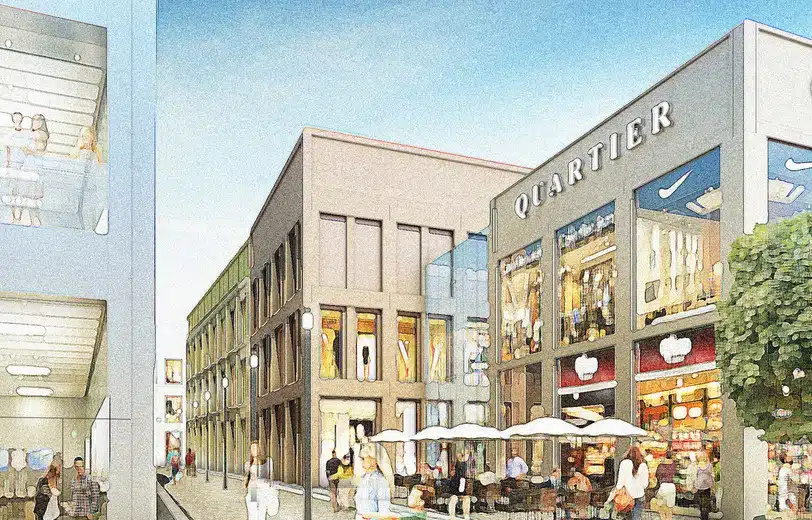
Boulevard Lu GmbH & Co. KG, a joint venture between local construction group Molitor and Sparkasse Rhein-Nahe, has developed the “LU:” shopping quarter since taking over the project’s planning in early 2016, following an earlier phase led by ECE Projektmanagement from 2011. Sparkasse’s involvement as a financing partner has helped keep the project moving despite its long timeline, rather than stalling entirely amid the bureaucratic delays common to major German inner-city redevelopments. The site occupies the former Karstadt department store area along Mainz’s Ludwigsstraße, one of the city’s main downtown arteries, first laid out under a decree of Napoleon in 1804. Mainz’s city council approved a formal building plan for the project in January 2021 after nearly a decade of public consultation forums, competitions and revised framework plans.
Since Karstadt’s closure and the old building’s demolition, a temporary pop-up concept called “lulu” has occupied part of the site since late 2020, hosting exhibitions, student design showcases and community events rather than permanent retail, functioning as a placeholder and a way to build public anticipation for the eventual project. The winning architectural competition design, selected in May 2020, centers on a rooftop park concept, with green roof gardens intended to be publicly accessible.
Construction on the project’s first phase, along Fuststraße and Gutenbergplatz, was underway as of early 2025, including a new building that will house a rehearsal and concert hall for the Mainz State Orchestra; Mainz’s city council separately voted in December 2025 to place a new municipal library in the same building. A second phase is intended to bring in fashion retailer Engelhorn as a retail anchor alongside tristar, a hotel operator rather than a conventional retail tenant, with an opening for the retail component targeted for sometime in 2026, according to the most recent reporting available.
That decade-plus gap between initial planning and an actual opening, an investor change, multiple public consultation rounds, and a temporary pop-up placeholder occupying the site in the meantime, reflects how thoroughly German inner-city redevelopment processes can extend timelines relative to greenfield retail construction, even for a project with strong municipal backing throughout.