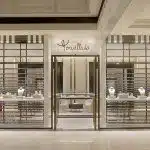
Pomellato is the Italian fine jewelry house founded in 1967 in Milan by Pino Rabolini, who revolutionized fine jewelry retail by introducing prêt-à-porter principles to the Italian fine jewelry sector. The house is owned by Kering, the French luxury conglomerate that also controls Gucci, Saint Laurent, Balenciaga, Bottega Veneta, Alexander McQueen, Brioni, and additional luxury houses, having acquired Pomellato in 2013.
Rabolini’s founding insight applied ready-to-wear retail principles (collections sold off the shelf, seasonal product refresh, color-and-design-led merchandising) to a fine jewelry industry that had operated almost exclusively on bespoke-commission and unique-piece models. The Nudo collection (introduced in 2001 and featuring distinctive faceted gemstone rings without claw-set traditional construction), the Iconica collection, the Sabbia collection, and the Catene chain collection became defining product anchors that continue as core commercial drivers. Kering reported group revenue of approximately €17.2 billion in 2024, with the Watches and Jewellery segment (Pomellato, DoDo, Boucheron, Sowind Group brands) contributing a measurable share of group sales. Pomellato has maintained its Milanese design and creative direction under Kering ownership, with Sabina Belli serving as CEO from 2015 and providing creative continuity. The brand suspended Russian operations in 2022. Strategic initiatives have included expanded ethical-gold sourcing programs, recycled-gold positioning, and the recent integration of DoDo (the younger Pomellato-sister brand for everyday fine jewelry).
Pomellato distributes through approximately 60 standalone boutiques globally, with the strongest concentrations in Italy, the United States, France, the United Kingdom, Switzerland, Germany, Japan, China, Hong Kong, and the Middle East. Distribution is supplemented by selected premium multi-brand fine jewelry retailers, department store concessions, and travel retail. For mall operators, Pomellato is a Class A luxury specialty tenant for top-tier shopping centers and luxury wings, typically taking 80 to 150 square meters with high merchandise density and a defined boutique design under Kering architectural standards. Co-tenancy with Cartier, Bulgari, Van Cleef & Arpels, Tiffany & Co., and the broader luxury fine jewelry cluster defines the typical positioning.
Verified signals on brand expansion, store openings, and mall development. Free.
Free · No credit card · Unsubscribe any time