
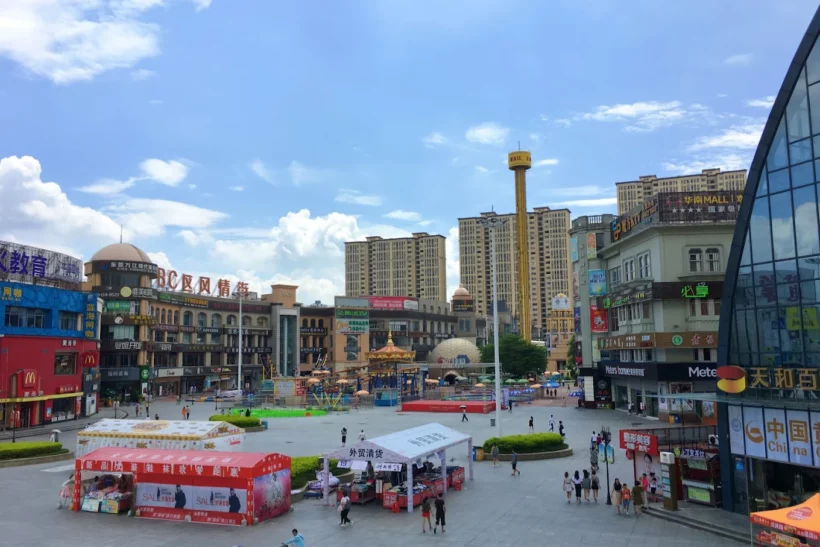
New South China Mall opened in Dongguan in 2005 as one of the most ambitious commercial developments ever attempted in China. The Wanjiang District property was conceived by instant-noodle billionaire Hu Guirong as a Las Vegas-meets-Disneyland destination, complete with a Venetian canal, gondola rides, and a replica Arc de Triomphe. With 600,000 square meters of gross leasable area, it ranks among the largest shopping centers in the world.
The mall’s first decade became a cautionary case study in retail real estate. Targeted at affluent shoppers from Guangzhou and Shenzhen but located in a city of migrant factory workers, it sat largely empty and was widely labeled a dead mall. Western media documented the vacant corridors, paused escalators, and scattered tenants for years.
The trajectory turned in the late 2010s. Founder Group, a Peking University affiliated holding company, acquired a controlling interest from Hu Guirong’s Sanyuan Yinghui investment vehicle. Extensive renovations followed, and CNN reported in 2015 that significant portions of the property had been filled with shops, restaurants, and entertainment tenants.
The current configuration includes more than 1,500 stores, an amusement park, an 18-screen cinema, and a hotel. Its scale alone places it in a small global tier alongside Mall of America, West Edmonton Mall, and Iran Mall by total leasable area.
For retail expansion teams, New South China Mall offers a high-volume Pearl River Delta outpost outside the Tier-1 anchors of Guangzhou and Shenzhen. Brand strategists watching the Dongguan story have learned that scale alone does not guarantee footfall. Catchment income, transit access, and tenant curation matter equally, and that lesson is now embedded in second-generation Chinese mega-mall planning.

