
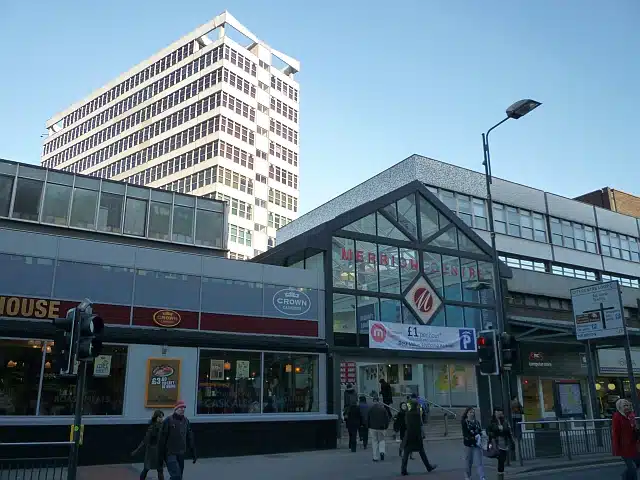
The Merrion Centre opened in 1964 in Leeds city centre at Wade Lane as the first covered shopping centre in England to be purpose-built at the time of its opening, a distinction that gives it historical significance beyond its current commercial scale. The mixed-use development has evolved through multiple extensions to incorporate retail, office, hotel, and car-parking uses in approximately 75,000 sqm of combined floor area. The centre is owned by Town Centre Securities as a long-standing Leeds commercial property asset.
The Merrion Centre’s 1964 opening preceded Brent Cross (1976) and was part of the mid-1960s wave of American-inspired covered shopping precinct developments in British city centres that modernist planners promoted as solutions to congested high streets. The Leeds city-centre positioning between the inner ring road and the Headrow connects the centre to the civic and university quarter of the city. The Merrion Hotel above the retail floors and the Merrion car park alongside constitute the full mixed-use proposition. While the subsequent opening of Trinity Leeds (2013) and Victoria Gate (2016) substantially repositioned the Leeds retail hierarchy, the Merrion Centre serves the northern city-centre pedestrian catchment from the Leeds Beckett University and the hospital district. The centre’s long operating history creates community familiarity and anchored relationships with tenants who have traded there for decades.
Leeds city centre’s population and daytime employment base of approximately 100,000 office and university workers provides the primary catchment. Bus services from the Merrion Street interchange provide transit access from across the Leeds metropolitan area. The northern city-centre position captures the university and hospital employment catchment that the newer southern developments are less accessible to on foot.
Town Centre Securities has managed the Merrion Centre since its original development in the early 1960s. As the oldest surviving purpose-built enclosed shopping centre in England, the property carries an inherent historic distinction that has no commercial equivalent in the current Leeds retail market regardless of its relative positioning against newer, larger-format competitors.
Verified signals on brand expansion, store openings, and mall development. Free.
Free · No credit card · Unsubscribe any time
Billed annually · View full comparison · Payment via invoice or PayPal



