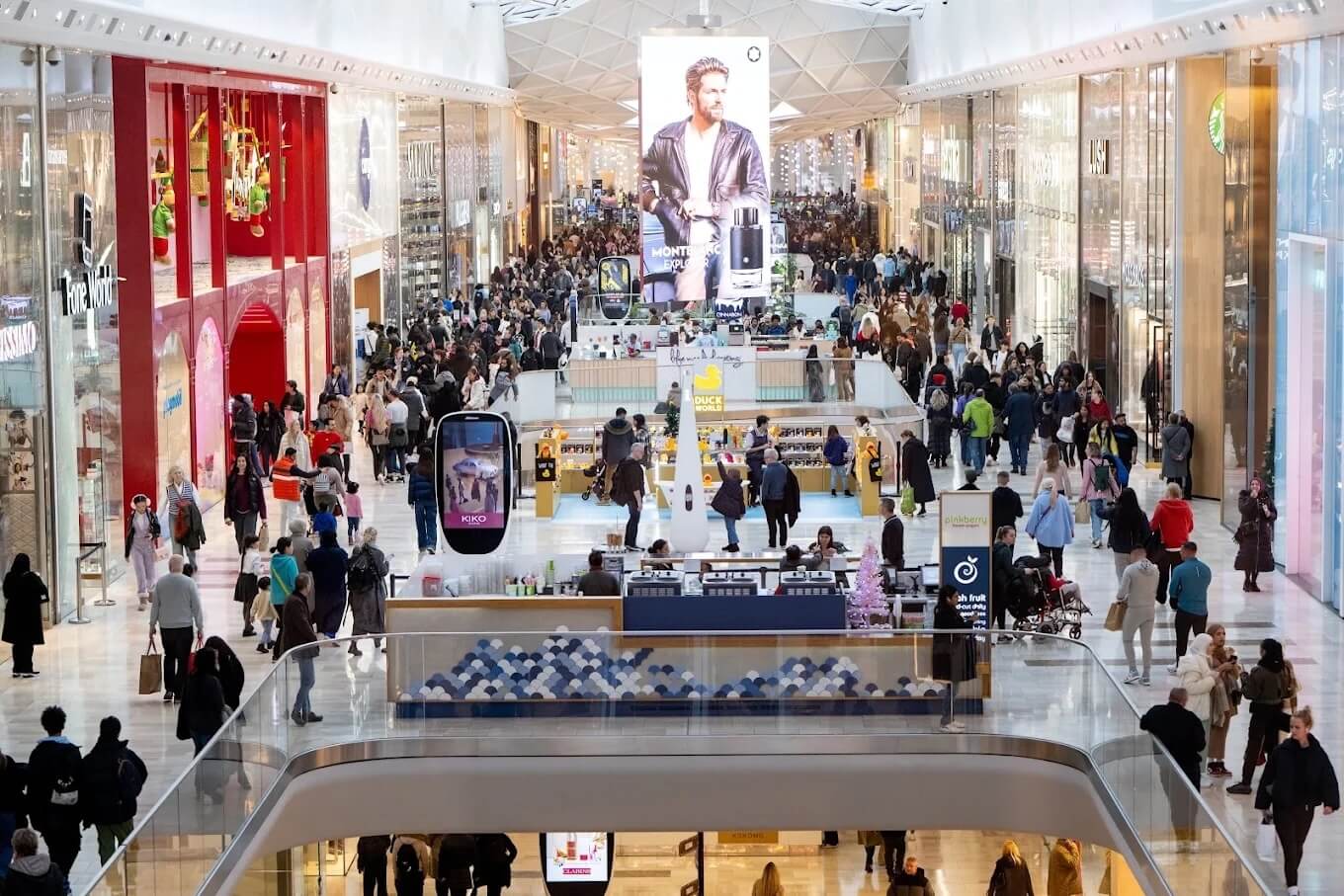
Grand Central Birmingham opened in September 2015 above and integrated with Birmingham New Street Station, one of the UK’s busiest intercity rail stations, with approximately 40,600 sqm of gross leasable area and a major mixed retail and dining offer. The development is owned by Hammerson, which completed 100% acquisition of Bullring & Grand Central in August 2025, as the station-integrated retail component of the New Street Station redevelopment that transformed Birmingham’s main rail gateway.
Grand Central’s defining commercial characteristic is its structural integration with Birmingham New Street: the retail concourse sits directly above the station’s concourse. The former John Lewis flagship permanently closed in 2020, one of the most significant anchor departures in UK retail during the pandemic period, and roughly half of that space remains vacant; Hammerson has planning consent for The Drum, an office-led mixed-use redevelopment of the unit with a gross development value of approximately £100 million, though as of early 2026 the scheme remained in design development rather than under construction. New Street handled approximately 52 million passenger journeys annually pre-pandemic and remains the busiest station in the UK outside London, creating a captive transit population that passes through the commercial zone independently of any retail shopping intention. The retail and food court circuit connects New Street Station to the Bullring via the Network Rail retail estate and the underground connection to Bullring’s lower-level entrances, creating one of the most transit-accessible retail circuits in the UK outside London.
Birmingham’s population of approximately 1.2 million and the West Midlands conurbation of approximately 2.9 million provide the regional catchment. New Street’s position as the hub of the Cross-City Line, one of the most intensively used rail routes in the UK outside London, channels a continuous stream of West Midlands commuters through the retail environment.
Hammerson manages Grand Central as the station-integrated retail asset that creates a captive retail audience from New Street’s commuter and long-distance passenger flows, a commercial model that depends fundamentally on the station’s role as the West Midlands rail network hub rather than on the attractiveness of the retail offer in isolation.
Verified signals on brand expansion, store openings, and mall development. Free.
Free · No credit card · Unsubscribe any time