
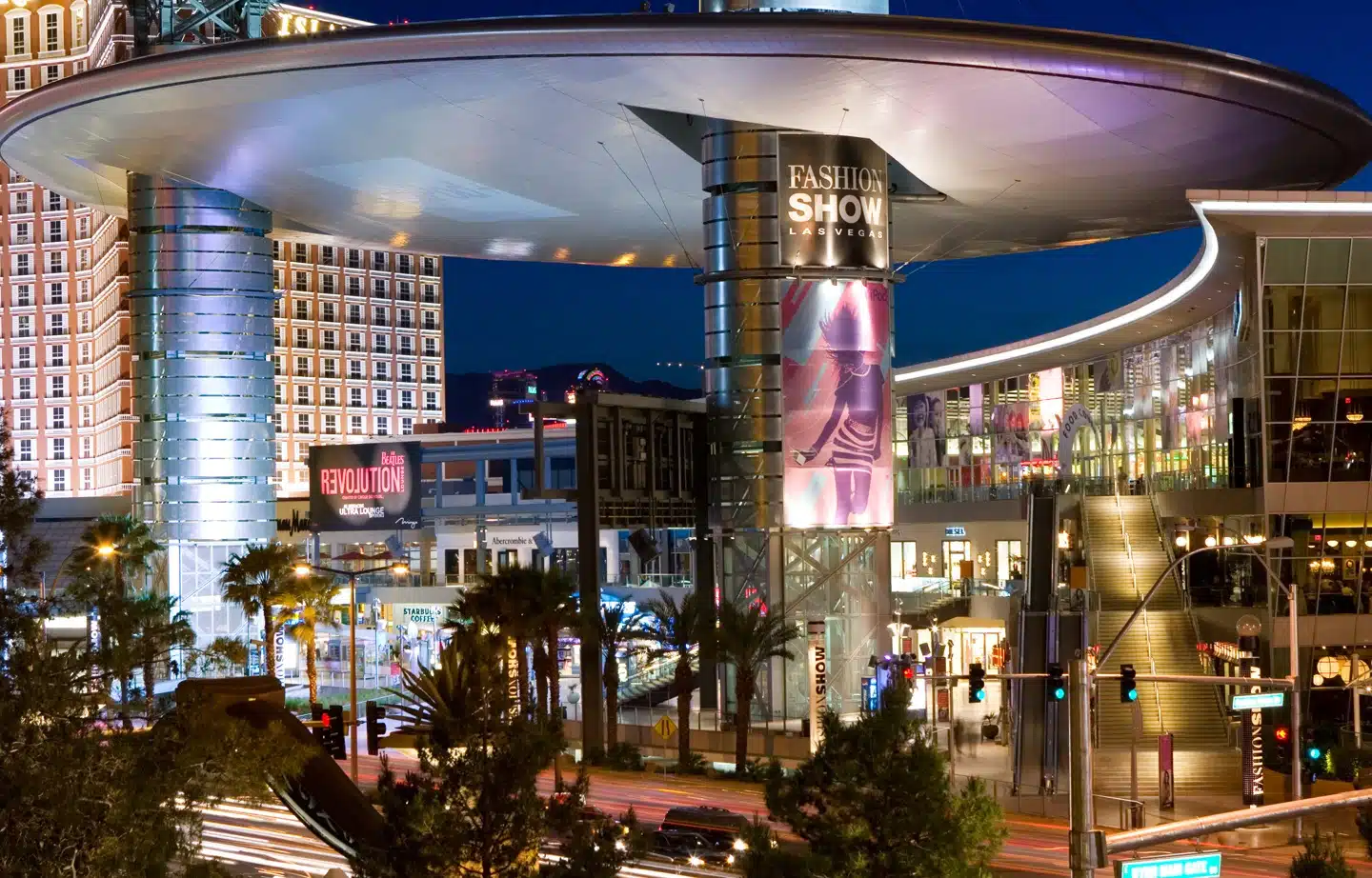
Fashion Show Las Vegas has historically operated with one of the deepest department-store structures in the United States, anchored by Dillard’s, Macy’s, Neiman Marcus, Nordstrom, and Saks Fifth Avenue. With Saks Fifth Avenue subject to closure by May 2026 as part of a broader Saks Global restructuring, the property’s operating thesis has shifted from legacy five-anchor dominance to Strip-scale mixed demand. The 2 million square foot asset now serves as a primary consolidation point for luxury tourism, convention traffic, and resident comparison shopping within a single enclosed structure on the Las Vegas Strip corridor.
The inline tenant mix reflects that dual traffic reality. Louis Vuitton and Gucci sit in the same corridor as H&M, JD Sports, and Express. lululemon, Anthropologie, and Free People occupy adjacent storefronts to Cotton On and PacSun. This compression of market tiers in a single structure is not a leasing inconsistency; it is a direct response to the customer mix arriving through the front doors. Conventioneers, luxury travelers, and Strip tourists generate high-spend occasion visits alongside the residents of Summerlin, Henderson, and the northwest metro who treat Fashion Show as the primary enclosed mall for their trade area.
Sports and entertainment retail anchors the lower level of the property. Dick’s Sporting Goods provides the category productivity for activewear and equipment, supported by Foot Locker, JD Sports, and Shoe Palace. POP MART and a Miniso presence confirm the collectible and specialty retail traffic that has become a measurable driver of dwell time at tier-one US enclosed malls. Maggiano’s Little Italy, California Pizza Kitchen, and Benihana anchor the food service register, with Luke’s Lobster and other fast-casual operators completing the dining floor.
For retail expansion teams, Fashion Show’s legacy five-anchor structure and current Strip-facing demand base make it a unique laboratory for understanding how enclosed malls function when anchored by tourism and convention traffic rather than residential trade areas. A brand testing its Las Vegas market entry here receives data on both visitor cohorts and resident shopping behavior within the same lease term. The Strip-facing position at the intersection of Las Vegas Boulevard and Fashion Show Drive produces unassisted walk-in traffic during peak periods that cannot be purchased through any media spend. For categories targeting both affluent visitors and the local mid-to-upper-income market, Fashion Show remains the qualifying address in the Las Vegas metropolitan retail hierarchy.
The property’s operating performance consistently ranks among the highest in gross sales per square foot for US enclosed malls, a function of the continuous tourist refresh rate rather than local household density alone. That metric, combined with the five-anchor draw and the inline mix depth, explains why expansion teams across luxury, athleisure, specialty, and dining categories have maintained long-term positioning here through multiple retail cycles.
Verified signals on brand expansion, store openings, and mall development. Free.
Free · No credit card · Unsubscribe any time
Billed annually · View full comparison · Payment via invoice or PayPal

